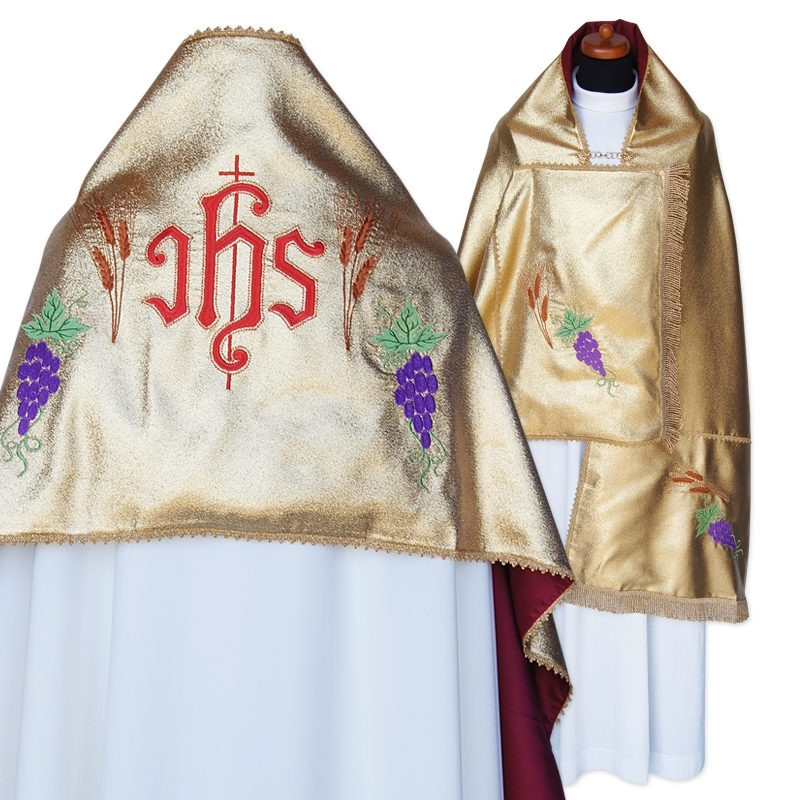
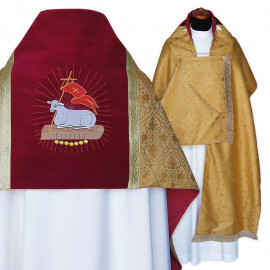
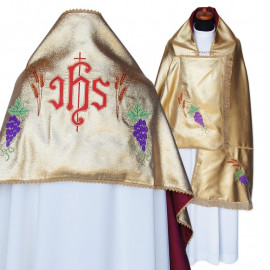
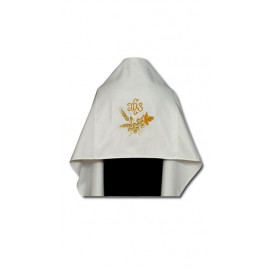
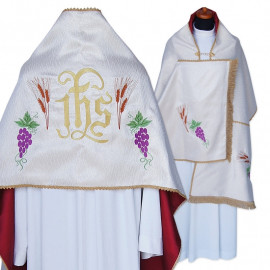
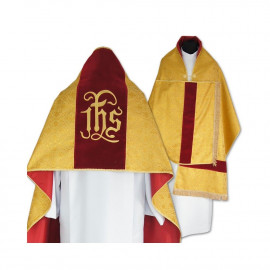

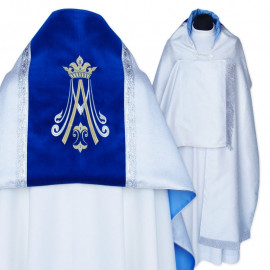
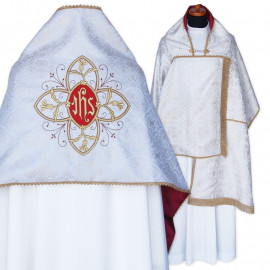
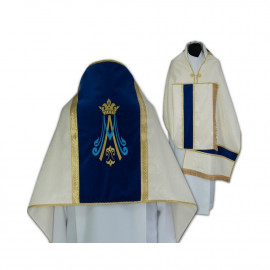
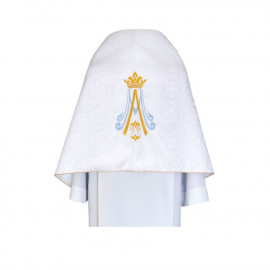
A humeral veil is a long, rectangular vestment worn over the shoulders by a Catholic priest or deacon when handling the Blessed Sacrament. Its two ends hang down in front and are used to cover the hands, so the minister does not touch the monstrance directly. The name comes from the Latin humerus, meaning shoulder.
The veil is most often seen at Benediction of the Blessed Sacrament and in Eucharistic processions. It is not worn at every Mass, and it is not the same as a cope, a vimpa, or a chalice veil. This guide explains the definition, the purpose, who wears it, and what to look for when choosing one for a parish or chapel.
The Definition of a Humeral Veil
The humeral veil — velum humerale in Latin — is one of the liturgical vestments of the Roman Rite, also used in some Anglican and Lutheran churches. It is a long rectangle of fabric, traditionally about 2.75 metres (110 inches) long and 90 centimetres (35 inches) wide, with two ribbon ties or a clasp near the breast to keep it in place.
It is not a cape. The middle of the veil rests across the back and shoulders, while the two ends are brought forward and crossed or held beneath the monstrance. That is why the traditional length matters: the veil must be long enough to cover the hands comfortably while still allowing the minister to move with reverence.
Our embroidered humeral veils are typically 250–300 cm long and 50–60 cm wide. Each product page lists the exact measurements, the fabric, and the embroidery motif.
What Is the Humeral Veil Used For?
The veil has a practical purpose and a symbolic one. Practically, it protects the sacred vessel from direct contact with the minister's hands. Symbolically, it shows that the blessing comes from Christ present in the Eucharist, not from the priest as a private person.
You will see the humeral veil at:
- Benediction of the Blessed Sacrament — the celebrant wears a cope and the humeral veil, raises the monstrance, and blesses the people.
- Eucharistic processions — including Corpus Christi and the procession after the Mass of the Lord's Supper on Holy Thursday.
- Reposition of the Blessed Sacrament — when the host is carried to the altar of repose or returned to the tabernacle.
- Viaticum — when Communion is brought to the dying outside Mass.
At Benediction with the monstrance, only the hands are placed under the veil. In other rites the veil may cover the sacred vessel itself. The veil is not used at an ordinary Mass where the Blessed Sacrament is not exposed or carried.
Who Wears the Humeral Veil?
The humeral veil is worn by the priest or deacon who handles the monstrance or carries the Blessed Sacrament. A bishop may also wear it. In the Solemn Mass of the older Roman Rite, the subdeacon used the veil to hold the paten from the Offertory until after the Pater Noster; this is the origin of many historical images of the vestment.
Altar servers do not normally wear a humeral veil. When a server holds the bishop's mitre or crosier, he uses a vimpa — a narrower veil of similar design. The humeral veil is wider and is reserved to the ordained minister who handles the Blessed Sacrament.
Why Does the Priest Cover His Hands?
The covered hands are a sign of reverence. The priest is not handling an ordinary object; he is handling the Blessed Sacrament. The veil keeps his hands from touching the monstrance and makes it visually clear that the blessing is given by Christ, not by the minister.
This is the same instinct that explains the chalice veil, the ciborium veil, and the vimpa: sacred things are handled with care, and the fabric becomes a visible sign of that care. The humeral veil is the largest and most solemn expression of that instinct.
What the Humeral Veil Is Not
Because several vestments are made of fabric and appear near the altar, they are often confused. The main differences are:
- Cope — the full-length outer cloak worn by the celebrant at Benediction and in processions. The humeral veil is worn over the cope. See our Catholic clergy copes.
- Vimpa — a narrower shoulder veil used by altar servers when holding the bishop's mitre or crosier.
- Chalice veil — a square cover placed over the chalice before and after the preparation of the gifts. See our chalice veils.
- Monstrance veil — a decorative cover for the monstrance when it is reserved or carried. See our monstrance veils.
- Ciborium veil — a cover for the ciborium containing the consecrated hosts. See our ciborium veils.
How to Choose a Humeral Veil
Three things matter most: the color, the size, and the fabric. The color normally follows the liturgical color of the day — white or gold, red, green, violet, rose, or black where permitted. The size should suit the monstrance and the celebrant: a heavy monstrance needs a longer, lined veil with a firm clasp. The fabric should match the cope or chasuble of the same set when possible.
Our collection includes 79 embroidered veils in brocade, velvet, satin, and damask, from $121 to $343. Browse the humeral veil collection or read our guide to Benediction vestments for the full list of what the celebrant wears.
Humeral Veil FAQ
Q: What does "humeral" mean?
A: “Humeral” comes from the Latin humerus, meaning shoulder. The humeral veil is named for the way it rests on the shoulders, with the two ends hanging down in front.
Q: Is a humeral veil the same as a cope?
A: No. The cope is the full-length outer cloak worn by the celebrant; the humeral veil is the long rectangle worn over the shoulders, often over the cope, to cover the hands or the sacred vessel.
Q: Can a deacon wear a humeral veil?
A: Yes. The humeral veil may be worn by a priest or deacon when handling the Blessed Sacrament, especially at Benediction and in Eucharistic processions.
Q: What is the difference between a humeral veil and a vimpa?
A: A vimpa is a narrower shoulder veil used by altar servers when holding the bishop's mitre or crosier. The humeral veil is wider and is worn by the ordained minister who handles the Blessed Sacrament.
Q: How long is a humeral veil?
A: The traditional length is about 2.75 m (110 in) and the width about 90 cm (35 in). Our veils run from 250 cm to 300 cm long and 50 cm to 60 cm wide.
Q: Do Anglicans and Lutherans use a humeral veil?
A: Yes. The humeral veil is used in the Roman Rite and also in some Anglican and Lutheran churches, especially for Benediction and Eucharistic processions.
Q: What color humeral veil should I use?
A: Use the liturgical color of the day: white or gold for Christmas, Easter and feasts of the Lord; red for Pentecost, Good Friday and martyrs; green for Ordinary Time; violet or purple for Advent and Lent; rose for Gaudete and Laetare Sunday.
Related reading: Benediction vestments · Benediction step by step · monstrance veils · chalice veils.