
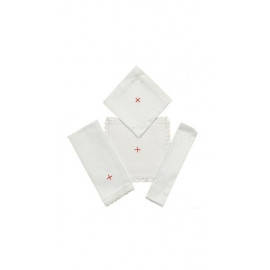
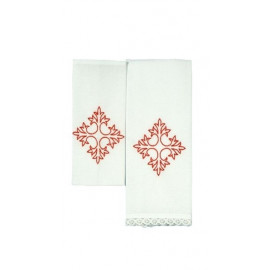


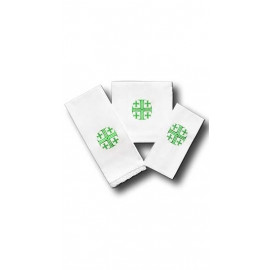

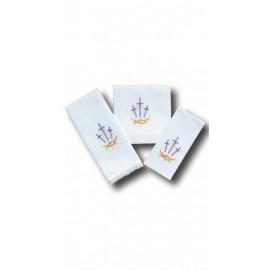
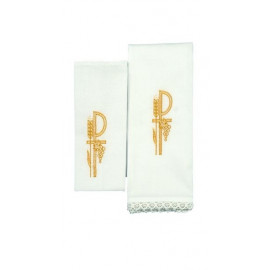


An altar cloth is the textile covering of the altar in a Christian church. In the Catholic tradition it serves three purposes: it is a sign of reverence for the altar, a decoration that follows the liturgical color of the season, and a practical protection for the altar table and the sacred vessels placed on it. The term covers several distinct linens — the white fair linen laid on top of the altar, the decorated frontal (antependium) that hangs at the front, and the smaller chalice linens used at Mass.
What Is an Altar Cloth Called?
Depending on which cloth you mean, you will hear several names:
- Altar cloth or altar tablecloth — the general name for the cloth that covers the altar table. In our collection these are the embroidered altar tablecloths with a decorated front panel.
- Altar linen(s) — the collective term for all the textiles of the altar: the fair linen, corporals, purificators, palls, veils, and burses.
- Fair linen — the white, hemmed linen cloth that covers the top of the altar; it is the one cloth that must be on the altar for Mass.
- Frontal or antependium — the decorated cloth hanging down the front of the altar, traditionally in the liturgical color of the day.
- Altar covering — any cloth that covers the altar, including the simple dust cover used when the altar is not in use.
The 5 Sacred Linens (and the Full Altar Set)
The "five sacred linens" most often refers to the five linens closest to the Eucharist:
- Fair linen — the white cloth that covers the altar top.
- Corporal — the square linen on which the chalice and paten rest during Mass.
- Pall — the stiffened square that covers the chalice during the Canon of the Mass.
- Purificator — the small cloth used to wipe the chalice.
- Chalice veil — the square cover for the chalice before the Eucharistic Prayer.
A sacristy usually holds a few more pieces beyond the five: chalice linen sets that combine the corporal, purificator, and pall; the burse that carries the folded corporal; the corporal itself; the finger towel and lavabo towel; and the ciborium veil or chalice veil for the vessels. We sew each of these with matching embroidery, so a parish can coordinate the whole sanctuary for each season.
What Are the Rules for Altar Cloths?
The General Instruction of the Roman Missal (no. 304) directs that the altar on which Mass is celebrated be covered with at least one white cloth, whose shape, size, and decoration suit the structure of the altar. In practice, parishes follow a few simple rules:
- At least one white cloth — traditionally the hemmed fair linen — must cover the altar table for Mass.
- A decorated frontal or antependium at the front is traditional and usually matches the liturgical color of the season.
- Altar linens are kept clean, pressed, and free of creases, and are reserved for liturgical use.
- Only the fair linen is strictly required; lace edges, embroidery, and side drops are customs that vary from parish to parish.
Worn or torn linens should be repaired or reverently retired — never used for ordinary household purposes.
Altar Cloth Colors and the Liturgical Year
Altar cloths and their embroidery follow the liturgical colors of the Church year: white and gold for Christmas, Easter, and the feasts of the Lord and Our Lady; green for Ordinary Time; violet and purple for Advent and Lent; red for Pentecost, Good Friday, and the feasts of martyrs; and rose for Gaudete and Laetare Sunday. Black may still be used for requiem Masses where local tradition allows. Many parishes keep a tablecloth or frontal in each color so the altar matches the vestments of the day — see our complete guide to liturgical colors for the full calendar.
How to Choose and Size an Altar Cloth
Measure the altar top first, then add an overhang of about 15–20 cm (6–8 in) at each end. Our standard width is 1.30 m (51 in), with lengths from 3.00 m (118 in) to 4.60 m (181 in); longer, shorter, and wider cloths are sewn to order, so any altar can be fitted exactly. The embroidery runs along the front of the cloth, repeating roughly every 35 cm (13.8 in) and standing 15–30 cm (5.9–11.8 in) high, depending on the design. Choose the motif — IHS, Jerusalem cross, Heart of Jesus, Marian, or another Eucharistic symbol — to match your vestments and the character of the sanctuary. Browse the full range in our embroidered altar tablecloth collection.
How Much Do Altar Cloths Cost?
Our embroidered altar tablecloths start at $125 for a standard width of 1.30 m (51 in) and a length of 3.00 m. Current price ranges by design family:
| Design family | Designs | Price range |
|---|---|---|
| Eucharistic symbols | 97 | $145–$173 |
| Marian designs | 34 | $125–$270 |
| IHS monogram | 32 | $125–$365 |
| Cross designs | 20 | $125–$173 |
| Christmas designs | 10 | $145–$198 |
| Jerusalem Cross | 5 | $125–$210 |
| Other symbolic designs | 49 | $125–$222 |
201 of the 247 designs cost under $150. Custom sizes and side embroidery are quoted individually, and orders over $100 ship free.
How to Care for Altar Cloths
Wash altar linens separately in cold water with mild detergent — never bleach — and iron them while still damp. Store tablecloths flat or rolled to prevent creasing. For a step-by-step walkthrough, see How to Wash Liturgical Linens, and for the smaller linens see What Is a Corporal and How Is It Used?
Frequently Asked Questions About Altar Cloths
What is the tablecloth on the altar called?
The cloth that covers the altar is most commonly called an altar cloth, and — in the context of the table it covers — an altar tablecloth. The white linen cloth laid on top of the altar for Mass is specifically called the fair linen, while the decorated cloth hanging at the front is the altar frontal or antependium. "Altar linens" is the general term for all the textiles of the altar.
What are the five sacred linens?
The five sacred linens are the fair linen (the white cloth on the altar), the corporal (on which the chalice and paten rest), the pall (which covers the chalice during Mass), the purificator (used to wipe the chalice), and the chalice veil (which covers the chalice before the Eucharistic Prayer). Some sacristies also count the finger towel, burse, and credence cloth among the sacred linens.
What are the rules for altar cloths?
The General Instruction of the Roman Missal requires that the altar be covered with at least one white cloth, fitting the shape and size of the altar. A decorated frontal or antependium is traditional and may follow the liturgical color of the season. Altar linens should be kept clean, free of creases, and reserved for liturgical use.
What is the best material for an altar cloth?
The Church requires a white cloth but does not mandate a fiber. Linen is the traditional choice for the fair linen because it is absorbent, lint-free, and durable. For the decorated tablecloth in everyday parish use, a stain-resistant fabric that holds embroidery well and irons easily is the practical choice — our embroidered altar tablecloths are made from stain-resistant fabric, and selected designs are finished with a guipure lace or baratto embroidered edge.
What size altar cloth do I need?
Measure the altar top first, then add an overhang of about 15–20 cm (6–8 in) at each end. Our standard width is 1.30 m (51 in) with lengths from 3.00 m (118 in) to 4.60 m (181 in); custom dimensions are sewn to order, so any altar can be fitted exactly.
What is the difference between an altar cloth and a fair linen?
The fair linen is one specific altar cloth: the white, hemmed cloth that covers the top of the altar and on which the corporal, chalice, and paten rest. "Altar cloth" is the broader term — it includes the fair linen, the decorated tablecloth or frontal, and the smaller chalice linens.
Where can I buy an altar cloth?
You can buy embroidered altar cloths directly from Best Catholic Shop. Every tablecloth is sewn to order in our workshop, in standard or custom sizes, with embroidery in all liturgical colors — see the full collection above or contact us for a custom quote.
