
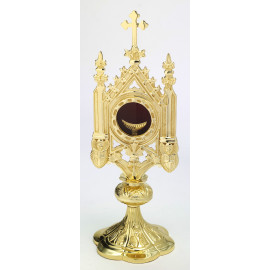
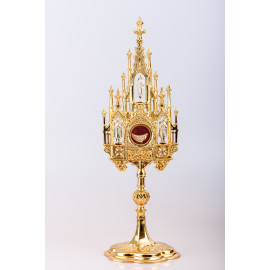
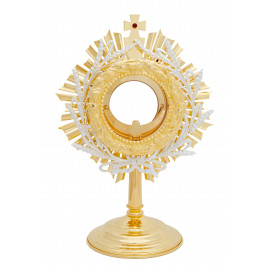
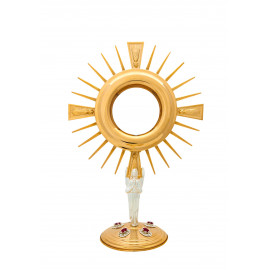
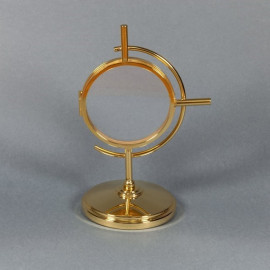
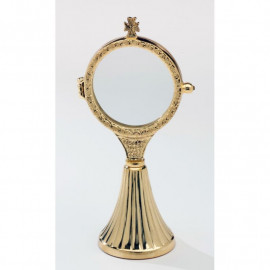
What Is a Monstrance?
A monstrance (also called an ostensorium) is a sacred vessel used in the Catholic Church for the exposition and Benediction of the Blessed Sacrament. The word comes from the Latin "monstrare," meaning "to show," reflecting its purpose of displaying the consecrated Host for adoration.
Design and Symbolism
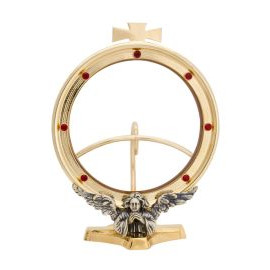
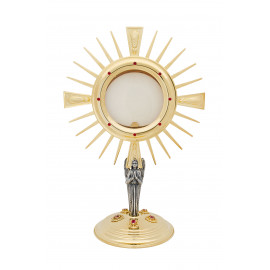
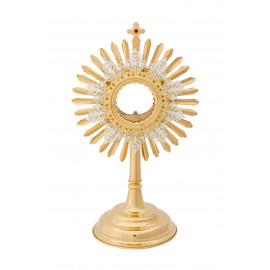
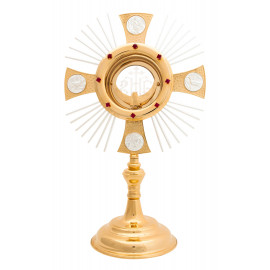
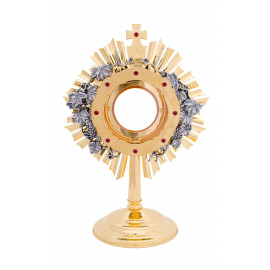
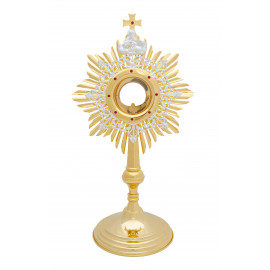
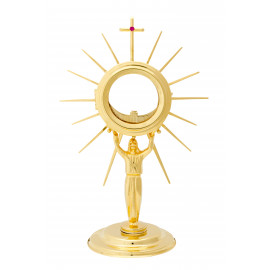
Traditional monstrances feature a central glass luna (holder) for the Host, surrounded by a sunburst design of rays symbolizing the light of Christ. The base is typically decorated with religious symbols, and the entire piece is crafted from brass, silver, or gold-plated metal.
The symbolism is deliberate: the rays of the sunburst present the host as the light of the world, the cross or crown at the top proclaims Christ's kingship, and the glass window keeps the consecrated host visible from every direction. Every element — from the node on the stem to the engraved base — serves the single purpose of making the Blessed Sacrament easy to see and adore.
Types of Monstrances
- Chapel monstrances — smaller, designed for personal or small-group adoration
- Processional monstrances — larger, with a sturdy base and handle for carrying in processions
- Tabor monstrances — designed for permanent exposition in a tabernacle or adoration chapel
- Large host monstrances — built around an oversized luna for hosts of 12.5–14.5 cm
- Home or oratory monstrances — compact 17–20 cm designs for domestic chapels
Our Collection
Our 14 monstrances for sale are handmade in Poland from cast brass and finished with 24-carat gold gilding (selected elements are galvanically plated with pure gold or silver). Heights run from 17 cm to 52 cm, prices from $242 to $2,698, and every order over $100 ships free. Whether you need a compact chapel monstrance for a side altar or a large church monstrance for solemn exposition, the collection covers the full range of Eucharistic devotion.
Ostensoria: Another Name for a Monstrance
Ostensoria (singular: ostensorium or ostensory) is the traditional name for what we now usually call a monstrance — the vessel used to expose the consecrated host for veneration. Both words express the same purpose of "showing": monstrance comes from the Latin monstrare, and ostensorium from ostendere. In modern usage "ostensorium" refers specifically to the vessel used for the exposition of the Blessed Sacrament, while a monstrance may also serve as a reliquary for the public display of relics. Chapel-size ostensoria are the smaller designs, usually 17–25 cm (7–10 in) tall, made for adoration chapels, side altars and home oratories. For a closer look at the history and use of the vessel, read our guide: What Is a Monstrance and How Is It Used in Eucharistic Adoration?
Chapel Monstrance Sizes, Materials and Prices
A chapel monstrance is a smaller monstrance designed for a chapel, adoration room or side altar rather than for large processions. Our collection offers 14 chapel monstrances and ostensoria priced from $242 to $2,698, with heights from 17 cm to 52 cm and luna sizes for hosts of 125 mm and 145 mm. Each piece is made of brass with a gold-plated finish for a warm, durable shine.
| Size | Typical use | Price range |
|---|---|---|
| 17–20 cm | Home oratory, small chapel, large-host models | $242–$1,045 |
| 30–40 cm | Chapel, side altar, parish adoration | $479–$1,827 |
| 45–52 cm | Large church, solemn exposition and processions | $1,666–$2,698 |
Larger processional monstrances have a sturdy base and a handle for carrying the Blessed Sacrament, while tabor monstrances (also called a monstrance throne or stand) are designed for permanent exposition in a tabernacle or adoration chapel — see our monstrance tabor designs.
Parts of a Monstrance
Every monstrance is built from the same parts: the base (the foot that supports the vessel), the stem with its node, the luna or lunette — the glass holder in which the consecrated host is placed — and the rays of the sunburst design that surround it. A cross or crown usually tops the design, and a glass cover protects the host. The word "luna" comes from the crescent-shaped metal ring that holds the host inside the lunette. Smaller custodia vessels in the same family — mini monstrances for exposing or carrying a single host — are available in our liturgical custody collection.
Neo-Gothic and Traditional Monstrance Styles
Monstrances come in several styles. The classic sunburst design surrounds the host with radiating rays; neo-gothic monstrances add pointed arches and tracery inspired by medieval cathedrals; traditional designs use baroque scrollwork and figures. The most elaborate designs — sometimes called apostle monstrances — carry figures of the twelve apostles around the luna. A good example from our collection is the Neo-Gothic monstrance 40 cm, with gothic detailing and a luna for hosts up to 3 cm in diameter.
The History of the Monstrance
The monstrance developed in the 13th century together with the feast of Corpus Christi, instituted by Pope Urban IV in 1264 after the visions of St. Juliana of Liège. As devotion to the Real Presence grew, the Church needed a dignified vessel in which the consecrated host could be carried in procession and shown to the faithful — earlier the host had been displayed in a simple pyx or covered casket.
Medieval monstrances took the form of tower-like reliquaries in the Gothic style; from the Renaissance and Baroque periods onward, the sunburst design — a round glass window surrounded by rays of gold — became the standard form. Baroque silversmiths made the rays ever more elaborate, adding angels, clouds and enamel work, while 19th- and 20th-century workshops returned to Gothic forms. The word "monstrance" itself comes from the Latin monstrare — "to show" — the same root as "demonstrate": the vessel exists to show the Blessed Sacrament to the people.
What Is a Monstrance Used For?
A monstrance is used for the exposition of the Blessed Sacrament: the consecrated host is placed in its luna and the vessel is set on the altar or a throne, so that the faithful can adore Christ present in the Eucharist. It is used at Eucharistic adoration (including Holy Hour and Forty Hours devotion), at Benediction of the Blessed Sacrament — when the priest blesses the congregation with the monstrance while wearing a humeral veil — and in Corpus Christi processions, when the Blessed Sacrament is carried through the streets or around the church. Read our step-by-step guide to Benediction of the Blessed Sacrament, and see our embroidered monstrance veils and processional canopies used on these occasions. For processions themselves, see The Role of Processions in Catholic Worship.
Monstrance vs. Tabernacle, Ciborium and Custody
| Vessel | Purpose |
|---|---|
| Monstrance / ostensorium | Displays the host for adoration, Benediction and processions |
| Tabernacle | Locked receptacle that reserves the Blessed Sacrament between liturgies |
| Ciborium | Holds many hosts for the distribution of Holy Communion |
| Custody / luna | The inner holder in which the host is clipped inside a monstrance |
| Pyx | Small vessel for carrying Communion to the sick |
The monstrance is the only one of these vessels designed for showing the Blessed Sacrament. The tabernacle keeps it, the ciborium serves Holy Communion, and the custody or luna is the monstrance's inner holder. For a wider overview of all of them, see The Complete Guide to Catholic Altar Vessels, and for a detailed comparison read Monstrance vs. Tabernacle vs. Ciborium.
Large Host Monstrances
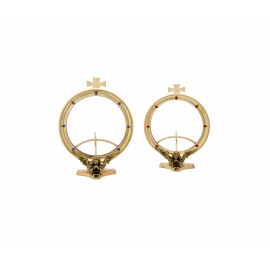
Some parishes expose a large consecrated host for adoration, and for that a standard luna is too small. A large host monstrance is built around an oversized glass ring — our two large-host models hold hosts of 12.5 cm and 14.5 cm, and the 45 cm church monstrance is also designated for a large host. The 18 cm monstrance for a 12.5 cm host features a ring set with rubies and a patinated angel; the 20 cm monstrance for a 14.5 cm host comes with a stone-set ring in blue or red. Both are cast brass with a galvanic gold finish.
How to Choose the Right Monstrance
Three questions decide the choice. Where will it stand? A home oratory or small chapel works with a 17–20 cm monstrance; a parish chapel or side altar calls for 30–40 cm; a large church or processional use needs 45–52 cm so the host stays visible from the back of the nave. What host will you expose? Most of our monstrances take a traditional host, while the large-host models take 12.5 cm or 14.5 cm hosts. Which style suits the church? Sunburst designs are timeless, neo-gothic suits traditional sanctuaries, and baroque scrollwork matches older continental churches.
Also check the base for stability (important when the monstrance is carried), and remember that a used or antique monstrance must be inspected for a missing luna or damaged glass before purchase — see our checklist: Antique and Used Monstrances. A full walk-through of sizes, luna options and styles is in our guide How to Choose a Monstrance for Your Church or Chapel.
Caring for a Monstrance
Keep the glass of the luna spotless — fingerprints and dust obscure the host during adoration. Clean the glass with a soft, lint-free cloth and dust the metal with a dry soft cloth; gold-plated brass needs no abrasive polish, which can wear through the gilding. Handle the luna by its edges only, and store the monstrance in the sacristy safe or a locked cabinet when not in use. For storage of monstrances alongside chalices and ciboria, see our guide: How to Store Sacred Vessels Safely.
How Much Does a Monstrance Cost?
A Catholic monstrance typically costs between $242 and $2,698 at our shop, depending on size, finish and craftsmanship. Chapel-size monstrances with a gold-plated brass finish start at $242; larger designs of 40–52 cm range from about $1,500 to $2,698. Silver and more ornate designs cost more. All orders over $100 ship free. See the full breakdown in our price guide: How Much Does a Monstrance Cost?
What Is the Difference Between a Monstrance and an Ostensorium?
They are the same vessel. "Monstrance" and "ostensorium" (plural: ostensoria) both name the sacred vessel used to display the consecrated host during Eucharistic adoration and Benediction. "Ostensorium" is the older term and refers only to the vessel of exposition, while "monstrance" can also describe a vessel that holds relics for veneration — see our liturgical reliquaries.
Is It Okay to Have a Monstrance in Your Home?
Yes — keeping a monstrance in a home chapel or oratory is acceptable when it is treated with reverence as a sacred object. Chapel-size monstrances of 17–25 cm are made for exactly this setting, and home monstrances of this size are also the most affordable way to equip a private oratory. Remember that the Blessed Sacrament itself may only be exposed by a priest or deacon and is reserved in a tabernacle, so in the home a monstrance is kept as a devotional object of prayer rather than used for public exposition.
Why Do Catholics Use a Monstrance?
Catholics use a monstrance to make the consecrated host — the Real Presence of Christ in the Eucharist — visible for adoration, Benediction and processions. The sunburst design expresses the light of Christ, and the elevated vessel allows the faithful to gaze upon the Blessed Sacrament in prayer, a devotion practiced since the Middle Ages.
Why Does the Priest Not Touch the Monstrance?
The priest does handle the monstrance — what he never touches with bare hands is the consecrated host, which is placed in the luna with the greatest reverence. When the monstrance is carried in procession or used for Benediction, the priest covers his hands with a humeral veil (monstrance veil), a sign that the blessing comes from Christ himself.
Do I Need a Monstrance Veil or Cover?
A monstrance veil (also called a humeral veil) is used whenever the Blessed Sacrament is carried or blessed with the monstrance — during processions, Forty Hours devotion and Benediction. It is a wide shoulder veil with pockets for the hands, usually matching the liturgical color of the day. Browse our embroidered monstrance veils.
What Is a Monstrance Stand or Throne?
A monstrance stand — also called a throne or tabor — is the elevated support on which the monstrance is placed for exposition in a chapel or on the altar. Tabor stands make the Blessed Sacrament clearly visible during longer periods of adoration. See our tabor and monstrance stands.
Why Is the Monstrance Shaped Like a Sun?
The sunburst shape is a symbol, not a decoration: the round glass window with radiating rays presents the host as the sun — Christ, the light of the world, whose Real Presence shines from the center. The design became standard in the Baroque period and expresses both the glory of the Eucharist and the Church's joy in showing it: everything radiates from the Blessed Sacrament at the center.
What Is Inside a Monstrance?
Inside the monstrance's glass window sits the luna (lunette) — a crescent-shaped metal ring that holds the consecrated host upright. The host is the only content of the monstrance: it is placed there for exposition and removed afterwards. Between uses, a monstrance is empty and is kept as a sacred vessel.
What Is a Luna in a Monstrance?
The luna (from the Latin for "moon," also called the lunette) is the two-part holder — a crescent ring with a glass window — in which the consecrated host is clipped inside the monstrance. Its crescent shape and polished metal grip keep the host standing upright and visible during adoration. Lunettes are sized to the host: the Neo-Gothic model in our collection takes hosts up to Ø 3 cm, while the large-host monstrances take lunas for 12.5–14.5 cm hosts.
What Is the Difference Between a Monstrance and a Ciborium?
A monstrance displays the Blessed Sacrament — it holds a single host in a glass luna so that the faithful can see and adore it. A ciborium holds many hosts for the distribution of Holy Communion at Mass; it is a covered bowl, not a display vessel. You would use a ciborium at Mass and a monstrance for adoration and Benediction.
What Is the Difference Between a Monstrance and a Tabernacle?
A tabernacle is the locked receptacle in which the Blessed Sacrament is reserved between liturgies — a permanent dwelling place in the church. A monstrance is the vessel that displays the host during adoration, Benediction and processions. The two work together: the priest removes the Blessed Sacrament from the tabernacle, places the host in the monstrance's luna for exposition, and returns it to the tabernacle afterwards.
The lamp that burns before that tabernacle — the sanctuary lamp — is the standing sign of the Real Presence between liturgies.
Related Reading
For Benediction, the celebrant wears a cope and uses the humeral veil; see our Catholic copes.
