







What Is a Gothic Chasuble?
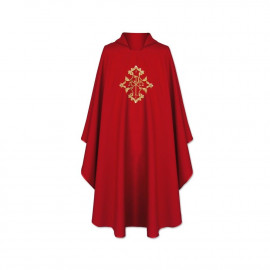
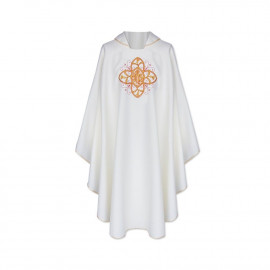
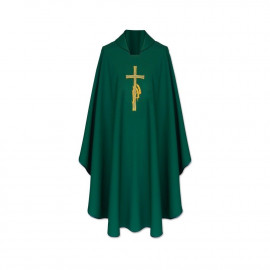
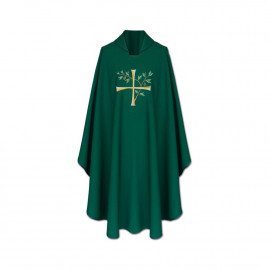
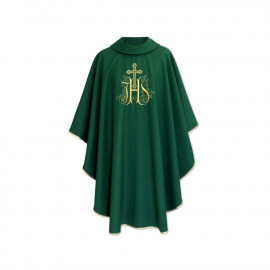
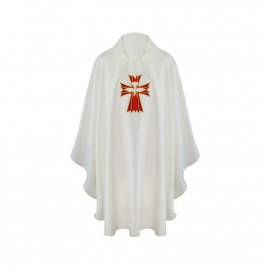
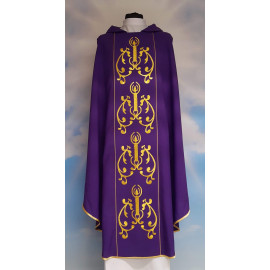
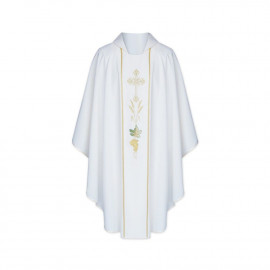
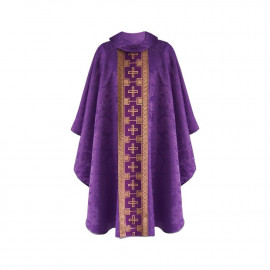
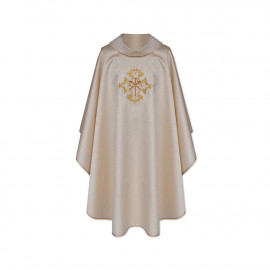
A Gothic chasuble is the full-cut, flowing form of the chasuble — the outermost vestment worn by a Catholic priest at Mass, over the alb and the stole. Its front and back panels run the full length of the body, the yoke is broad across the shoulders, and the sides fall almost to the wrists, so the whole vestment drapes in one deep, unbroken fold. The name "Gothic" describes the cut, not the architecture: it recalls the full medieval shape of the garment, in contrast to the shorter, fitted Roman chasuble.
The word chasuble comes from the Latin casula, "little house" — a small hooded cloak — and the vestment developed from the paenula, an everyday outer cloak of antiquity (definition after Wikipedia, "Chasuble"). In the Roman tradition the chasuble is understood as the yoke of Christ: the vesting prayer asks that the priest may bear it with joy, and the garment is a sign of the charity that should clothe the celebration of the Eucharist.
This collection gathers 72 Gothic chasubles from $153 to $599.99. 71 of the 72 are embroidered, 16 carry the IHS monogram, 70 describe a cross or crucifix motif, and every model is supplied with a matching stole. All are made in Poland.
Gothic vs Roman Chasuble: What Is the Difference?
The difference is the cut. A Gothic chasuble is wide, long and flowing: the fabric covers the shoulders and upper arms and falls in a heavy drape that may need to be gathered over the forearms. A Roman chasuble — in its most fitted form the fiddleback — is shorter and narrower, shaped closely at the shoulders, with a back cut into a cross or violin form that leaves the arms completely free.
The two also belong to different habits of celebration. The Roman cut is the classic vestment of the Traditional Latin Mass, where the priest's gestures at the altar are many and precise. The Gothic cut is the everyday vestment of most modern parishes: it is worn at Novus Ordo Masses, at concelebrations and at solemn celebrations where a fuller, more forgiving drape is wanted. Neither is more valid than the other; both are legitimate Catholic vestments and both are made in every liturgical colour.
For a side-by-side comparison read our guide Roman chasuble vs Gothic chasuble, and for the most fitted Roman form see fiddleback chasuble explained. Our Roman chasubles collection covers the fitted Latin Mass cut.
Gothic vs Semi-Gothic Chasuble
A semi-Gothic chasuble keeps the full-length front panel of the Gothic cut but trims the width and the volume, so the vestment sits closer to the body, drapes more lightly and leaves the hands freer. The full Gothic cut is wider and heavier, with a deeper fold over the arms and a more generous silhouette.
In practice the choice comes down to the celebrant and the building: the Gothic cut gives the most traditional, covering drape and reads well in a large sanctuary, while the semi-Gothic cut is easier to wear for a priest who moves a great deal or serves in a smaller church. All 72 chasubles on this page are full Gothic; if you want the lighter middle cut, see our semi-Gothic chasubles.
Chasuble Cuts Compared
| Cut | Shape | Drape | Typical use |
|---|---|---|---|
| Roman (fiddleback) | Short, narrow front; cross-shaped or violin-shaped back | Fitted; arms completely free | Traditional Latin Mass, solemn celebrations |
| Semi-Gothic | Full-length front panel, reduced width | Mid-weight; lighter than full Gothic | All Masses, modern parishes |
| Gothic | Full-length front and back panels, broad yoke | Wide and heavy; covers the arms almost to the wrists | Novus Ordo, concelebrations, processions |
| Conical | Bell-shaped, no defined yoke | Even fall from the shoulders | Contemporary and monastic design |
Monastic chasubles are a further variant: broad and simple, often with little ornament, associated with monastic communities. The conical cut reproduces the bell-shaped form of the earliest vestments — no defined yoke, an even fall from the shoulders — and is common in contemporary design. Both are distinct from the Gothic cut, which has a broad but defined shoulder yoke.
History: From the Medieval Chasuble to the Gothic Revival
The chasuble began as a large conical cloak — in Latin casula, "little house". By the Middle Ages it had become the full, circular garment that the Gothic cut still reproduces: a wide oval of fabric with an opening for the head, falling over the arms and often covered with embroidery. The best medieval examples were worked in coloured silks, gold thread and figurative scenes, and the vestment was the most conspicuous surface a parish could decorate.
In the centuries after the Council of Trent (1545–1563) the cut was gradually reduced for practicality. Through the 17th, 18th and 19th centuries the Roman style was tailored ever more closely, until the fiddleback had reduced the chasuble to a narrow, stiff panel with a shaped back. The reaction came in the 19th century with the Gothic Revival: architects and liturgists led by Augustus Pugin and the Cambridge Camden Society (founded 1839) argued for a return to the medieval form, and vestment makers began to produce full-cut chasubles again. The revival produced its own variant, the "Gothic Revival" style, which is less full than the regular Gothic cut and often has a pointed hem and neckline.
The liturgical movement of the 20th century confirmed the Gothic cut as the ordinary vestment of the Roman rite, and the General Instruction of the Roman Missal (no. 336) names the chasuble as the vestment proper to the priest celebrant at Mass. For the wider story see our guide the history of the chasuble and the evolution of liturgical vestments.
Fabrics, Orphreys and Embroidery
The 72 chasubles are built on four main fabric families. Brocade is the most common (24 models): a rich, figured weave with metallic thread, traditionally reserved for the great feasts. Jacquard (15 models) gives a patterned weave at a lighter weight, damask (10 models) a subtle reversible figure, and georgette (2 models) a soft, matte drape. 10 listings state a 100% polyester composition, and 17 models are finished with velvet — a velvet belt or band down the centre, a velvet cowl neck, or velvet stripes.
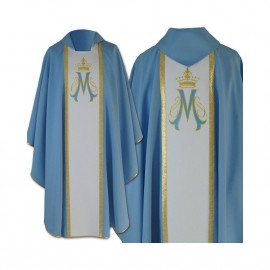
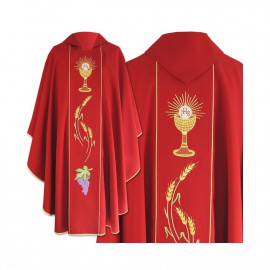
The decoration is concentrated on the orphrey — the band that runs over the shoulders and down the front and back of the vestment. On these chasubles the orphrey carries the embroidery: a cross or crucifix (70 models), the IHS monogram (16), floral and rosette designs, the Heart of Jesus, the Pelican, the Dove, Alpha and Omega, or an image of Our Lady and the saints. 13 listings specify gold metallic thread. 26 models describe a decorated belt at the centre, either velvet or plain, often finished with gold ribbons.
Because the embroidery sits on the centre band, it is the part of the vestment that needs the most care when the chasuble is stored or ironed. For the anatomy of the garment see our guide to the parts of a chasuble.
Liturgical Colours Available
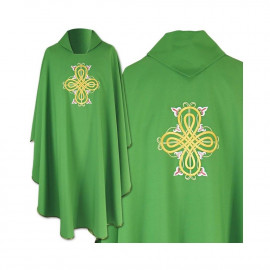
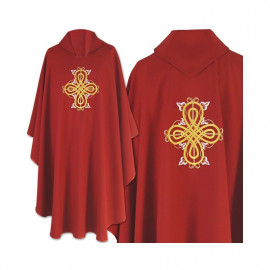
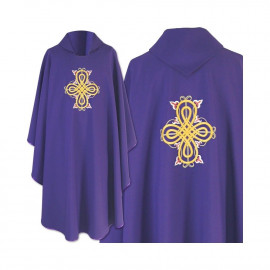
Gothic chasubles are made in every liturgical colour, and the colour of the vestment follows the day or season. In this collection, models are named in red (5), green (5), purple (6), white (3), ecru (6) and gold (10), while 15 listings are offered in a choice of liturgical colours — useful when a parish is building a complete set.
| Colour | When it is worn |
|---|---|
| White / gold | Christmas, Easter, feasts of the Lord, Our Lady and the saints |
| Red | Pentecost, Palm Sunday, Good Friday, apostles, evangelists and martyrs |
| Green | Ordinary Time |
| Violet / purple | Advent, Lent, Reconciliation and funerals |
| Rose | Gaudete Sunday (Advent) and Laetare Sunday (Lent) |
| Black | All Souls' Day and funeral Masses, where customary |
Shop by colour: white, red, green, purple, black, pink, gold and ecru.
Seasonal selections: Christmas chasubles, Easter chasubles, wedding chasubles, Marian chasubles and chasubles with saints. For the calendar itself see the complete guide to liturgical colours.
Size and Fit: 127 × 158 cm
71 of the 72 chasubles follow the same measured pattern: 127 cm (50 in) long and 158 cm (62.2 in) wide across the widest part of the vestment. The consistent cut means a priest who already wears a Gothic chasuble will find the same drape here, and a replacement or an additional colour will hang identically.
26 listings note that the size can be adjusted to individual needs, and 27 mention a lining — usually made on request. If the celebrant is unusually tall or short, or the parish wants a lined vestment for a cold church, contact us before ordering so the workshop can confirm the measurement and the lead time. Our guide how to measure for a chasuble explains which dimensions matter.
What Is Included With Each Gothic Chasuble?
Every chasuble in this collection is supplied with a matching stole, and 63 of the listings describe it specifically as an inner stole — the stole worn crossed over the breast, under the chasuble. The set is therefore ready for Mass without buying the stole separately.
These are chasuble-and-stole sets, not full Roman sets: they do not include the maniple, burse or chalice veil that traditionally accompany the fitted Roman cut. If you need those pieces, see our Roman chasubles (22 of them are complete sets) and our embroidered stoles for additional colours.
Gothic Chasuble Prices
Prices in this collection run from $153 for a simple cross-motif model to $599.99 for an embroidered Marian design with a velvet belt. The distribution across the 72 models:
| Price range | Models |
|---|---|
| $153–$199 | 12 |
| $200–$299 | 21 |
| $300–$399 | 36 |
| $400 and up | 3 |
Three things move the price: the fabric (brocade and velvet cost more than a plain polyester weave), the density of the embroidery (a single embroidered cross versus a full figurative image), and the finish (velvet belt, gold ribbons, a lined body). A simple Gothic chasuble with an embroidered cross at $153 sits at the bottom of the range; the embroidered Marian chasuble with a velvet belt at $599.99 at the top. For a wider view of the market see how much does a chasuble cost.
Care and Washing
The product descriptions for the polyester models state that the fabric is breathable, crease-resistant and suitable for standard washing and ironing, and that the quality of the weave helps the colour keep its shade. Embroidered vestments still deserve gentle treatment: wash at a low temperature, avoid bleach and harsh detergents, and never iron directly over embroidery or gold thread — press on the reverse, through a cloth.
Store the chasuble on a wide padded hanger or rolled flat, away from direct sunlight and damp, and use a breathable garment bag for travel so the embroidery does not snag. For deeper cleaning, use a specialist dry cleaner. More in our guide how to care for embroidered vestments.
When to Wear a Gothic Chasuble
The Gothic cut is the ordinary vestment of the modern Roman rite: it is worn at parish Masses, at concelebrations, at solemnities and at processions, in the colour proper to the day. It is also legitimate at the Traditional Latin Mass — the Gothic form is the older of the two cuts — although the fitted Roman or fiddleback vestment is the more common choice there.
Because the Gothic chasuble covers the arms, it traps more warmth than a Roman cut; in summer or in a heated church a lighter polyester or jacquard weave is more comfortable, while brocade and velvet suit the great feasts. For the symbolism of the garment see what does the chasuble symbolize.
Made in Poland — Our Own Workshop
Our Gothic chasubles are sewn and embroidered in Poland, in our workshop in Lublewo Gdańskie. Working directly with the vestment makers means consistent quality, honest fabric descriptions and the ability to arrange custom sizes, colours and embroidered images on request. See Made in Poland for details.
In-stock chasubles are dispatched within 72 hours and reach the United States by FedEx in about 2–5 business days; made-to-order and custom pieces add 3–14 business days before dispatch. Orders over $100 ship free within the United States. Full details are in the shipping information and the returns policy.
Frequently Asked Questions
What is the difference between a Gothic and a Roman chasuble?
A Gothic chasuble is wide and flowing, with full-length front and back panels and a broad yoke that covers the arms almost to the wrists. A Roman (fiddleback) chasuble is shorter, narrower and fitted at the shoulders, with a cross-shaped back that leaves the arms completely free. Both are valid Catholic vestments; the Roman cut is customary for the Traditional Latin Mass, while the Gothic cut is the everyday vestment of most parishes.
What is the difference between a Gothic and a semi-Gothic chasuble?
The semi-Gothic cut keeps the full-length front panel of the Gothic chasuble but trims the width and volume, so it drapes more lightly and leaves the hands freer. The Gothic cut is wider and heavier, with a deeper fold over the arms. All 72 chasubles in this collection are full Gothic; the lighter middle cut is collected in our semi-Gothic chasubles category.
Can a Gothic chasuble be worn at the Traditional Latin Mass?
Yes. The Gothic cut is the older, medieval form of the chasuble, and it is permitted at the Traditional Latin Mass. In practice many priests celebrating the older rite choose the fitted Roman or fiddleback cut, but a Gothic chasuble is a legitimate and historically grounded option.
What is a conical chasuble?
A conical chasuble is a bell-shaped cut with no defined yoke: the fabric falls in an even cone from the shoulders. It reproduces the earliest form of the vestment and is common in contemporary and monastic vestment design. It is distinct from the Gothic cut, which has a broad but defined shoulder yoke.
What is an orphrey on a chasuble?
An orphrey is the decorated band sewn onto a vestment, usually running over the shoulders and down the front and back. On Gothic chasubles the orphrey often carries the embroidery — a cross, an IHS monogram, or a floral or figurative design worked in gold thread.
What size is a Gothic chasuble?
71 of the 72 chasubles in this collection follow the same pattern: 127 cm (50 in) long and 158 cm (62.2 in) wide, measured across the widest part of the vestment. 26 listings note that the size can be adjusted to individual needs, and 27 mention that a lining can be added on request — contact us before ordering if the celebrant needs a different length or width.
Is a stole included with these Gothic chasubles?
Yes. Every chasuble in this collection is supplied with a matching stole, and 63 of the listings describe it specifically as an inner stole. The stole is worn crossed over the breast, under the chasuble.
What colours are Gothic chasubles made in?
The collection includes models named in red (5), green (5), purple (6), white (3), ecru (6) and gold (10), and 15 listings are offered in a choice of liturgical colours. The full range follows the liturgical year: white and gold, red, green, violet, rose and black.
How much does a Gothic chasuble cost?
Prices in this collection run from $153 for a simple cross-motif model to $599.99 for an embroidered Marian design with a velvet belt. 12 models cost under $200, 21 cost $200–$299, 36 cost $300–$399 and 3 cost $400 or more.
How do you clean and store a Gothic chasuble?
Store it on a padded hanger or rolled flat, away from sunlight and damp. Spot clean with a soft cloth, never bleach, and never iron directly over embroidery or gold thread. For deeper cleaning use a specialist dry cleaner. Our guide to caring for embroidered vestments covers the details.
Are Gothic chasubles machine washable?
The product descriptions for the polyester models state that the fabric is suitable for standard washing and ironing, but embroidered vestments should be treated gently: use a low temperature, avoid bleach and harsh detergents, and never iron over the embroidery. Always check the care label of the individual model.
Where are your Gothic chasubles made?
All of our Gothic chasubles are made in Poland, in our workshop in Lublewo Gdańskie. Working directly with the vestment makers lets us offer custom sizes, colours and fabrics on request — see Made in Poland.
Can a deacon wear a Gothic chasuble?
No. The chasuble is the vestment of the priest celebrant; a deacon wears a dalmatic instead. See our embroidered dalmatics for the matching deacon vestment.
What is the best fabric for a Gothic chasuble?
Brocade gives the richest look for solemn feasts (24 models in this collection), jacquard and damask are lighter and suit regular parish use (15 and 10 models), and 100% polyester weaves are the easiest to care for and the coolest in summer (10 models). Choose the fabric by season, climate and how often the vestment will be worn.
Related Reading
- Roman Chasuble vs Gothic Chasuble: Key Differences Explained
- How to Choose a Chasuble: Complete Guide for Priests and Sacristans
- The History of the Chasuble: From Ancient Rome to Modern Altars
- Fiddleback Chasuble: Why It's Called That and How It Differs from a Roman Chasuble
- Parts of a Chasuble: Orphreys, Cross, Stole, Maniple and Burse Explained
- How to Measure for a Chasuble: Sizing Guide for Priests and Sacristans
- How Much Does a Chasuble Cost? Price Ranges Explained
- More from this family: all embroidered chasubles · Roman chasubles · semi-Gothic chasubles · Marian chasubles · chasubles with saints · wedding chasubles · Christmas chasubles · Easter chasubles · linen chasubles
